Welcome to Our 1st Issue! LESSGOO
Some ideas hit different. Your brain lights up. You see the logo, the landing page, the moment it all clicks. You tell yourself: this could be huge.
We've been there. Way too many times.
Here's what we learned the hard way: most ideas don't die because of bad execution. They die because you started from the wrong place.
Let me show you what that looks like.
The Idea That Shouldn't Have Existed
A while ago, we got obsessed with something that sounded smart. Predicting demand by analyzing how products go viral online. It felt futuristic. It felt like the kind of thing a "real founder" would build. One problem. We had zero connection to the world we were trying to solve. We didn't understand supply chains. We didn't know anyone in that space. We didn't know the workflows, the frustrations, the daily grind. But we convinced ourselves it would work anyway. We bought the domain. Made notes that looked like strategy. Drew boxes on a whiteboard. For a moment, we felt like we were onto something. Then came validation. Cold messaging people who had no reason to care. Most ignored us. One D2C company replied: "We don't really face this problem." That was enough. We got rejected because the idea didn't come from reality. It came from imagination. And imagination alone is the most dangerous place to build a company!
The Idea That Felt Effortless
Months later, we stumbled on something completely different. This time, it wasn’t a cool idea. It wasn’t some intellectual exercise. It was a small but frustrating problem we dealt with almost every day as designers. We made a simple tool for ourselves just to make our work smoother. Nothing flashy. Nothing “founder-like.” Just something that solved our irritation. When we shared it with a few friends, something surprising happened. People understood it immediately. They didn’t need a pitch. They didn’t need a deck. They didn’t need us to convince them. They already felt the same pain. And suddenly, validation wasn’t this big dramatic moment. It was just normal conversations with people who cared about the exact thing we cared about. That’s when we understood the difference. Bad ideas need to be sold. Good ideas are recognised. And the easiest ideas to validate are the ones that grow naturally out of your own world.
The Method We Follow Now
We stripped our process down to something simple.
Start with clarity. We don't touch ideas outside our world. If we don't feel the problem, if we can't explain the workflow, we drop it immediately.
Validate through trust. We talk to people who already know us. If an idea requires begging strangers to listen, it probably isn't rooted in a real need. Validation should feel like conversation, not torture.
Build the smallest version. Not a full product. Just enough for people to try and respond honestly.
This isn't a framework. It's a survival instinct.
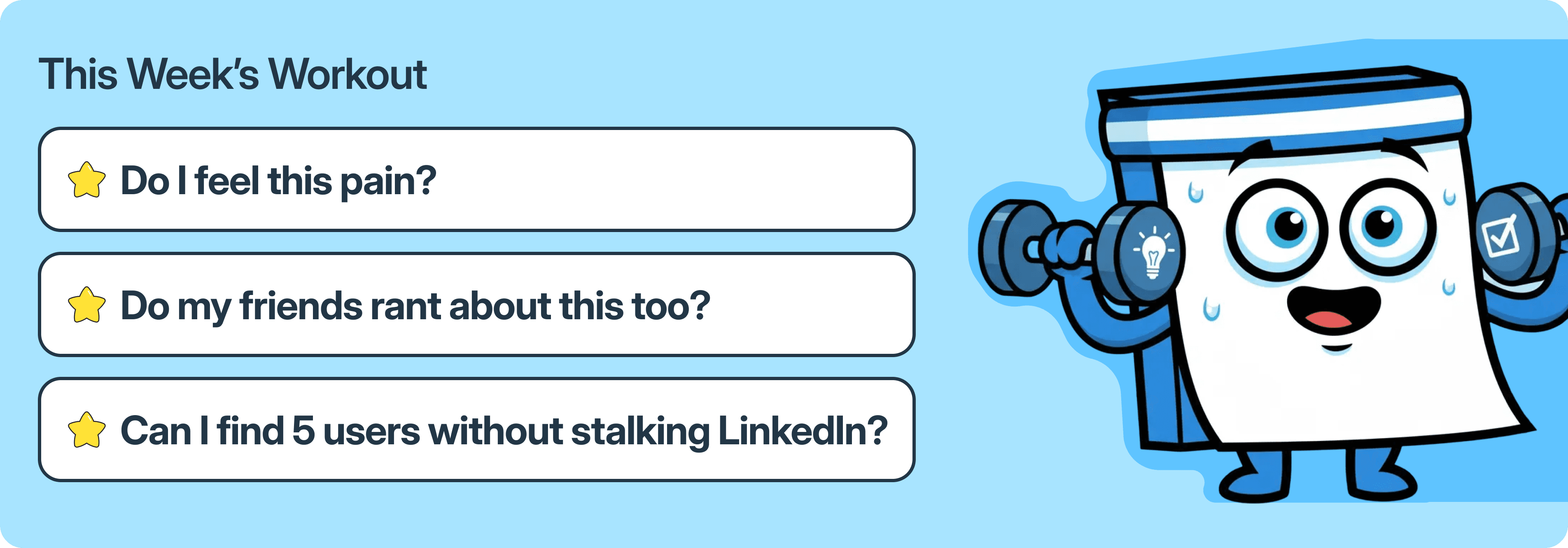
A Small Exercise For You This Week
Before you chase your next idea, ask yourself:
Do I personally feel this problem? Do people in my world feel it too? Can I talk to ten warm contacts about it today without hesitation?
If the answer is no, you're chasing noise.
If the answer is yes, you might have something real.
Before You Go
Most early founders burn months on ideas that were never meant to exist. We did it. It sucked. And we promised ourselves we'd never go down that path again.
The best ideas don't come from brainstorming. They come from proximity, from access, from problems you live with every day.
That's what this newsletter is about. We learn by building our own company, and we share the lessons so you don't repeat our mistakes.
Let's move smarter this time. See you next week!